
Updated June 2026: An essential guide for US homeowners on selecting high-CADR HEPA purifiers and activated carbon systems to combat intensifying wildfire smoke.
The intensity of recent wildfire seasons has fundamentally changed how we view the air inside our homes. For many Americans, particularly in the West and Northeast, wildfire smoke is no longer a rare event but an annual environmental challenge. This fine particulate matter, often referred to as PM2.5, is small enough to enter the bloodstream and poses a significant risk to respiratory and cardiovascular health.
When outdoor air quality reaches hazardous levels, your home should be your primary sanctuary. However, standard HVAC filters are rarely equipped to handle the microscopic soot and toxic gases found in heavy smoke. Effective protection requires a dedicated strategy focused on high-efficiency filtration and specialized gas adsorption.
This guide examines the best air purifiers for wildfire smoke in 2026, focusing on the HEPA models designed to handle high-volume smoke events.

Understanding the 2026 Wildfire Air Quality Challenges
Wildfire smoke is a complex mixture of gases, volatile organic compounds (VOCs), and microscopic particulate matter. According to the U.S. Environmental Protection Agency (EPA), fine particles are among the most significant health concerns because they can penetrate deep into the respiratory system and aggravate heart and lung conditions.
Even with windows and doors closed, wildfire smoke can enter a home through small cracks, joints, gaps around windows and doors, and ventilation systems. The EPA notes that outdoor smoke can infiltrate indoor spaces and significantly affect indoor air quality during wildfire events.
When comparing air purifiers, one of the most important performance metrics is the Clean Air Delivery Rate (CADR), which indicates how quickly a unit can remove airborne particles from a room. Filter composition is equally important, with HEPA filtration designed to capture fine particulate matter and activated carbon helping reduce certain gases and odors.
How HEPA and Activated Carbon Work Against Smoke
High-Efficiency Particulate Air (HEPA) filters are widely regarded as the most effective technology for removing airborne smoke particles. According to the U.S. Environmental Protection Agency (EPA), a true HEPA filter is certified to capture at least 99.97 percent of particles measuring 0.3 microns in diameter.
Because wildfire smoke contains large amounts of fine particulate matter (PM2.5), HEPA filtration can significantly improve indoor air quality during smoke events. Consumers should be cautious of terms such as “HEPA-like” or “HEPA-type,” as these products are not required to meet the same performance standards as certified HEPA filters.
Activated carbon is another important component of an air purifier. While HEPA filters are designed to capture particulate matter, activated carbon can help reduce odors and certain gaseous pollutants through a process called adsorption, in which gas molecules adhere to the surface of highly porous carbon. Because wildfire smoke contains both particles and gases, the EPA recommends considering air cleaners that combine particle filtration with gas-removal technologies where appropriate.
Comparing the Top HEPA Models for 2026
Selecting the right model depends on the volume of air you need to clean. The following table compares the leading units based on their performance metrics.
| Model | Smoke CADR | Recommended Room Size | Filter Life | Noise Level (Low/High) | Approximate Price |
|---|---|---|---|---|---|
| IQAir HealthPro Plus | 300 cfm | 1,125 sq. ft. | 12-48 months | 22 / 57 dB | $1.200 |
| Blueair Blue Pure 211i MAX | 410 cfm | 674 sq. ft. | 6-9 months | 23 / 53 dB | $205 |
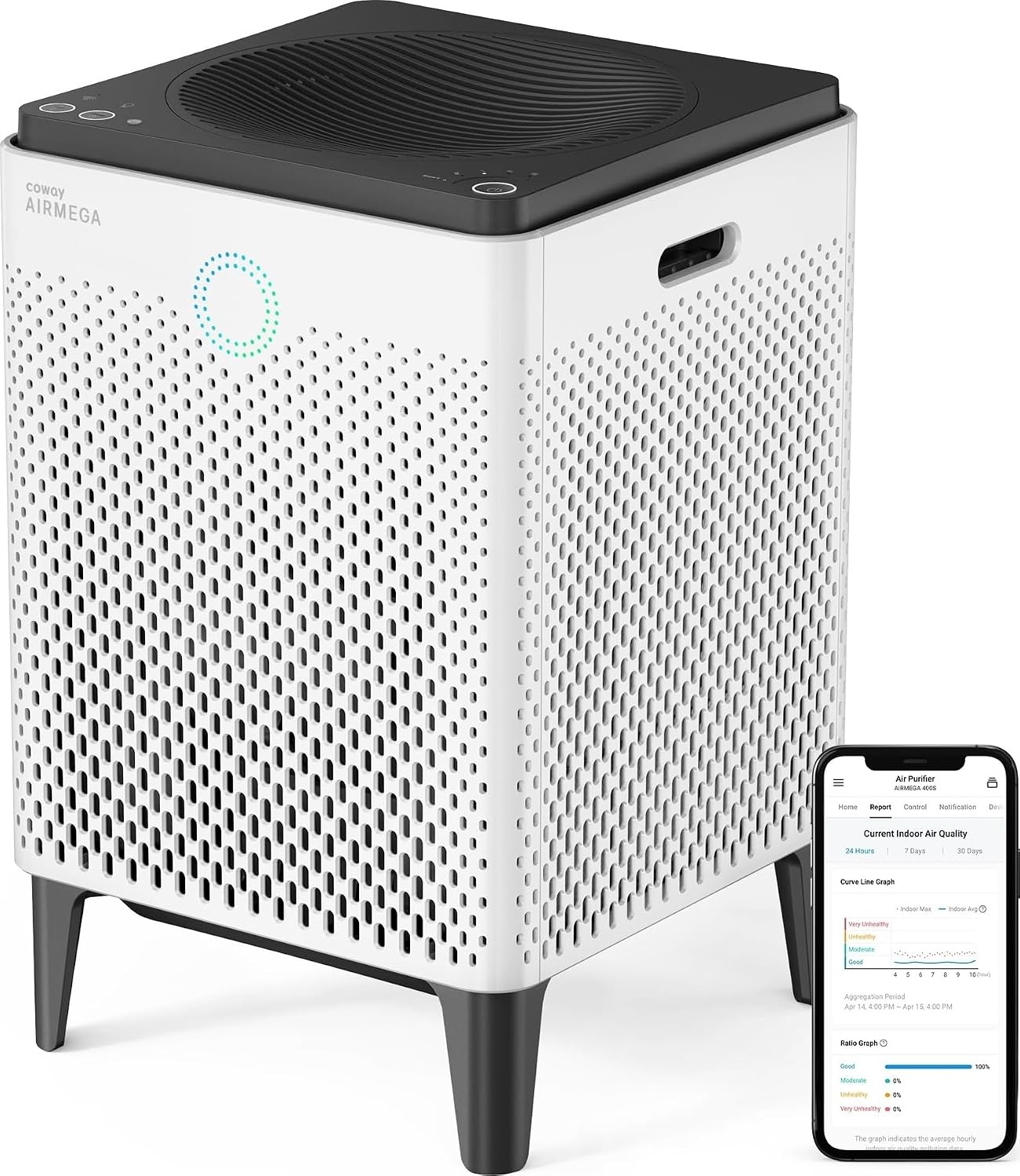
| Coway Airmega 400S | 328 cfm | 1,560 sq. ft. | 12 months | 22 / 52 dB | $650 |
| Levoit Core 600S | 410 cfm | 1,588 sq. ft. | 6-12 months | 26 / 55 dB | $300 |
| Austin Air HealthMate | 250 cfm | 1,500 sq. ft. | 60 months | 23 / 66 dB | $715 |
Model Recommendations and Real-World Performance
When evaluating these units, the Levoit Core 600S stands out for high-value performance. Its exceptionally high CADR makes it a reliable option for large living rooms or open-concept floor plans where rapid air turnover is vital.
For those prioritizing gas and odor removal, the IQAir HealthPro Plus remains a benchmark. While expensive, its HyperHEPA filtration and V-Max carbon filter are designed for clinical-grade air cleaning. This model has performed well in real-world use for individuals with pre-existing respiratory conditions like asthma or COPD who are highly sensitive to smoke.
 |
| Buy it on Amazon |
If you are looking for a “set it and forget it” solution, the Coway Airmega 400S features dual-sided suction and highly accurate laser sensors that ramp up fan speeds automatically when smoke is detected. It is a robust unit that handles heavy particulate loads without frequent maintenance.
 |
| Buy it on Amazon |
Setup and Placement Tips for Maximum Protection
The efficiency of an air purifier is heavily dictated by where you place it. During a wildfire event, the goal is to create a “clean room.” This is typically a bedroom or a central living area where family members spend the most time.
Place the unit at least 18 inches away from walls or furniture. Many purifiers pull air from the sides or back; blocking these intakes significantly reduces the CADR. Avoid placing purifiers in corners where air circulation is stagnant.
In a multi-story home, smoke often settles on the lower levels first, but it can also be pulled upward through “stack effect” in stairwells. If you have only one unit, keep it in the room where you sleep. If you have multiple, place one near the primary entry point of the home to catch smoke as people enter and exit.
Maintenance and Realistic Performance Expectations
Air purifiers are not a substitute for sealing your home. If your windows are drafty, even the best HEPA filter will struggle to keep up with the infiltration rate. Maintenance is also non-negotiable during smoke season.
Check your pre-filters weekly. During heavy smoke, these can become matted with ash and dust within days. A clogged pre-filter forces the motor to work harder, reducing its lifespan and decreasing air filtration efficiency. Most HEPA filters will need to be replaced sooner than the manufacturer’s “standard” estimate if they are used 24/7 during a wildfire.
It is also important to manage expectations regarding smell. While a high-quality carbon filter will reduce the “campfire” odor, it may not eliminate it entirely if the smoke concentration is extreme. The primary goal is the removal of the dangerous PM2.5 particles that you cannot smell or see.
When to Call a Professional
While portable air purifiers are excellent for localized cleaning, they do not address your home’s total ventilation. If you find that smoke odors are persistent even with purifiers running, it may be time to consult an HVAC specialist.
A professional can inspect your ductwork for leaks that may be pulling smoke from the attic or crawlspace into your living areas. They can also discuss the installation of a whole-home air cleaner or a high-MERV (Minimum Efficiency Reporting Value) filter for your central system. However, be cautious: older HVAC blowers may not be powerful enough to push air through a MERV 13 or 16 filter without causing system damage. A technician can verify if your system can handle upgraded filtration.
Safety Notes and Critical Disclaimers
Air purifiers are supplemental tools and should not be used as the sole reason to remain in a dangerous area. If local authorities issue an evacuation order due to fire proximity or extreme air quality hazards, leave immediately.
Be wary of purifiers that produce ozone. While often marketed as “ionizers” or “plasma” cleaners, ozone is a lung irritant that can exacerbate the very respiratory issues caused by smoke. Always ensure your unit is CARB (California Air Resources Board) certified as ozone-safe.
Frequently Asked Questions
How long should I run my purifier during a wildfire?
Run the unit 24/7 on the highest setting you can tolerate. Air quality can fluctuate rapidly, and consistent filtration is necessary to keep levels safe.
Can I wash my HEPA filter to make it last longer?
No. Washing a HEPA filter destroys the delicate mesh of fibers that trap microscopic particles. Always replace the filter according to the manufacturer’s instructions.
Do I need a purifier in every room?
Ideally, yes, but prioritizing the bedroom and the main living area is a practical starting point.
What is PM2.5 and why is it dangerous?
PM2.5 refers to atmospheric particulate matter with a diameter of less than 2.5 micrometers. These particles are small enough to pass through the lungs into the blood, causing systemic inflammation.
Will a “Standard” air filter work for smoke?
Most basic household filters (MERV 1-8) are designed to catch dust and hair, not smoke. You need a HEPA-rated filter for smoke particles.
How do I know if my air purifier is working?
Many modern units have built-in sensors and color-coded lights. Alternatively, you can purchase a standalone laser air quality monitor to verify PM2.5 levels.
Does wildfire smoke contain chemicals?
Yes. When structures burn, plastics, paints, and chemicals are released into the air, which is why a charcoal or activated carbon filter is necessary.
Is it safe to run a purifier near a sleeping baby?
Yes, provided the unit is placed safely and is not an ozone generator. The white noise can actually be beneficial for sleep.
Why does my purifier smell like smoke after the fire is out?
The activated carbon filter has likely become saturated and is now “off-gassing” the odors it trapped. This is a sign the filter needs to be replaced.
How often should I change filters during a heavy smoke season?
Expect to change them twice as often as the standard recommendation if the smoke is constant and heavy.
Conclusion
Investing in a high-quality air purifier is one of the most proactive steps you can take for your family’s health during wildfire season. By focusing on true HEPA filtration, substantial activated carbon, and proper room sizing, you can significantly reduce your exposure to hazardous pollutants. Stay informed on local air quality reports and ensure your equipment is maintained and ready before the first plume of smoke appears on the horizon.